
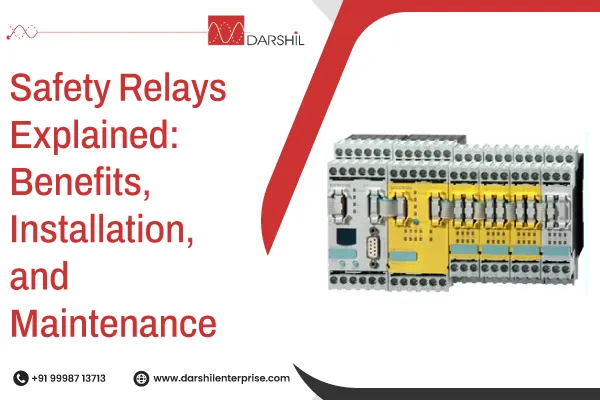
Electrical safety is one of the most important aspects of any industrial, commercial, or automated environment. As factories advance and automation becomes more complex, safety requirements continue to grow. Machines are faster, systems are smarter, and operations rely heavily on uninterrupted productivity. But with increased efficiency comes increased risk. A single fault or hazardous movement can put workers, equipment, and entire facilities in danger. This is where Safety Relays and Electrical Safety Relays play a crucial role in safeguarding processes.
What Are Safety Relays?
Safety Relays are specialized control devices used to monitor safety functions and activate protective responses when unsafe conditions appear. Unlike standard relays, safety relays are built with strict safety logic designed to reduce risks, stop machinery during hazards, and maintain safe operation conditions.
They are used for applications such as:
- Emergency stop monitoring
- Safety door switches
- Light curtain monitoring
- Two-hand control systems
- Safety interlocks
- Safe stopping of motors and actuators
- Overtravel and overspeed protection
Why Safety Relays Are Critical in Modern Automation
Today’s manufacturing and industrial environments involve high-speed machinery, robots, automated conveyors, presses, motors, and moving parts. Without reliable safety systems, the consequences could be immense.
The importance of Safety Relays can be understood through several key advantages:
- Higher Safety Integrity: Safety relays meet international safety standards such as SIL (Safety Integrity Level) and PL (Performance Level). This gives them structured and proven safety behavior that standard relays cannot achieve.
- Protection From Electrical and Mechanical Faults: Safety relays react instantly when detecting overloads, excess motion, improper machine movement, sudden stops, or unsafe access points.
- Reliable Emergency Shutdowns: Emergency stop systems are only reliable when the safety relay driving them is dependable. Safety relays provide precise, monitored shutdowns during hazardous events.
- Reduced Risk of Accidents: By constantly monitoring electrical circuits and safety devices, these relays lower the chances of workplace injuries.
- Improved Productivity Through Safe Operation: Safe machinery runs more confidently and avoids unexpected failures. This contributes to consistent productivity levels.
How Safety Relays Work: Internal Functioning
To understand how to select the right safety relay, you first need to understand how it operates. A safety relay performs three central tasks:
- Monitoring Safety Inputs: Safety relays receive signals from devices such as emergency stops, safety mats, light curtains, and interlocks. They continuously monitor these signals and detect any inconsistencies.
- Processing Safety Logic: Using redundant circuits, cross-monitoring contacts, and internal logic, the relay processes whether conditions are safe or unsafe.
- Activating Safety Outputs: Once a hazard is detected, the relay triggers an immediate response. This response can be cutting off power, stopping motors, isolating circuits, activating alarms, or resetting systems.
Applications for Safety Relays Across Industries
Safety relays are used in a wide range of environments, including:
- Manufacturing
- Robotics
- Assembly lines
- Pharmaceutical plants
- Textile industries
- Food processing
- Material handling
- HVAC machinery
- Packaging systems
- Chemical industries
- Foundries and heavy machinery setups
Benefits of Using Safety Relays
Using safety relays in your electrical and automated environment brings several major benefits that contribute to safety, productivity, and long-term performance.
- Guarantees Safe Operation: Machines operate under monitored conditions, reducing unexpected hazards.
- Supports Industrial Compliance: Safety standards and certifications require proper safety relay installation as part of risk-reduction strategies.
- Minimizes Downtime: Machines stop only when necessary, reducing unnecessary shutdowns.
- Lower Maintenance Costs: Safety relays detect faults early, preventing major mechanical or electrical issues.
- Long Operational Life: Good quality Electrical Safety Relays extend the operational life of safety circuits.
- Supports Easy Integration: Safety relays integrate smoothly with modern PLCs, controllers, and automation environments.
How to Install Safety Relays: Step-by-Step Guide
Installing safety relays requires precision and an understanding of electrical safety circuits. Below is a simplified explanation:
- Wiring Inputs: Connect emergency stops, guards, sensors, and switches to the input channels.
- Connecting Outputs: Outputs are connected to actuators, motor contactors, PLCs, or safety circuits responsible for stopping machinery.
- Control Voltage Setup: Provide the correct control voltage according to the relay rating.
- Reset Method: Decide between manual reset or automatic reset depending on safety requirements.
- Testing the System: Test every function, including emergency stop response, gate monitoring behavior, and fault detection, before starting machinery.
Correct installation improves reliability and prolongs the life of Electrical Safety Relays.
Maintenance Practices for Safety Relays
To keep safety relays functioning correctly, regular maintenance is crucial:
- Periodic inspection
- Checking for dust or moisture
- Testing safety input devices
- Monitoring relay contact movement
- Verifying proper reset function
- Checking wiring tightness
Proper maintenance prevents malfunction and supports uninterrupted safety control.
Why Choose Us
Darshil Enterprise stands as a trusted supplier of high-quality, certified safety components for industrial and commercial environments. Our experience helps industries make smarter, safer decisions when selecting Safety Relays and Electrical Safety Relays for their machinery. We believe every customer deserves accurate guidance, reliable products, and dependable performance. When you work with Darshil Enterprise, you receive genuine components, professional communication, and safety-focused solutions designed to support long-term operational stability. Our commitment to quality and customer satisfaction makes us a preferred choice for businesses seeking strong electrical safety systems.
Conclusion
Safety relays are a vital part of modern industrial and automated environments. They protect workers, machinery, and entire operations by monitoring safety devices, detecting faults, and triggering immediate protective responses. With the growing need for reliable safety functions, choosing high-quality Safety Relays or Electrical Safety Relays becomes essential for achieving consistent performance. Industries looking for dependable solutions rely on professionals like Darshil Enterprise to provide safe, accurate, and long-lasting products. Understanding the benefits, installation methods, and maintenance practices help you select the right safety relay for your application and strengthen your overall safety structure.
For more expert insights on safety relays, call +91 98983 38702 or email info@darshilenterprise.com