
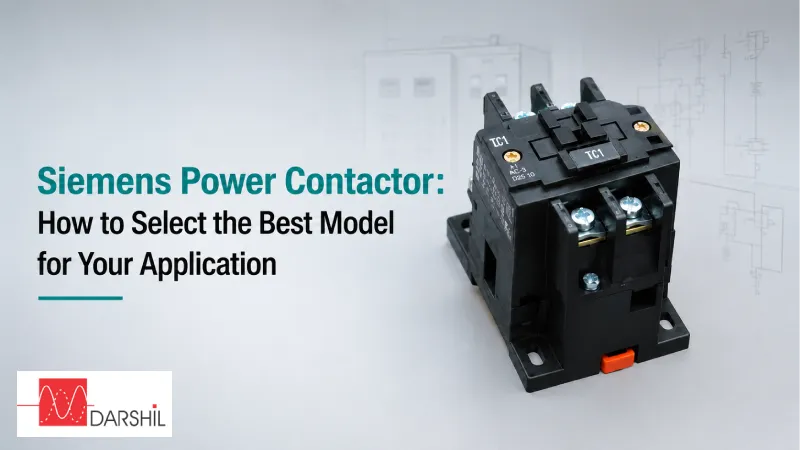
Key Takeaways
- Understand key factors like current rating and utilization category when selecting Siemens Power Contactors in Jamnagar.
- Choosing the right Siemens Power Contactors in Gandhidham ensures safety and operational longevity for industrial applications.
- Verify coil voltage compatibility to avoid installation delays or equipment failures.
- Select models based on the specific application type, such as motors or capacitor banks, to ensure optimal performance.
- Regularly check existing contactors for signs of wear to prevent unexpected breakdowns.
Industrial electrical systems rely heavily on robust switching components to manage heavy motor loads, lighting systems, and heating circuits safely. Among the various low-voltage switchgear options available in the global market, Siemens power contactors stand out for their exceptional durability, innovative engineering, and reliable performance. Choosing the correct model for a specific industrial or commercial requirement is vital for operational safety and longevity. Enterprises across vibrant industrial sectors often seek out genuine components supplied by Darshil Enterprise to maintain peak electrical efficiency.
Whether setting up complex manufacturing units or upgrading legacy panels, engineers need a thorough understanding of operational parameters, current ratings, and environmental conditions.
Understanding What a Power Contactor Actually Does
A power contactor is an electrically operated switch used to control the flow of current to motors, capacitor banks, heaters, lighting circuits, and other high-load industrial equipment. Unlike a simple switch that a person operates by hand, a contactor is controlled through a coil circuit, which allows it to open and close a much larger load circuit remotely, repeatedly, and safely. Because industrial machinery draws heavy inrush current on startup, ordinary switches wear out quickly, while a properly rated contactor is built to handle thousands of switching cycles without failure.
Siemens has built a strong reputation in this segment because its contactor ranges, including the widely used 3RT2 series, are engineered for reliability across a wide span of current ratings, coil voltages, and utilization categories. For plant engineers, panel builders, and maintenance teams across Gujarat, sourcing genuine Siemens components from an authorized supplier is the first step toward long-term equipment protection. It also means faster access to spares, accurate catalogue references, and clear technical guidance whenever a production line cannot afford to sit idle for long.
Why Selecting the Correct Contactor Model Matters
Installing an undersized or mismatched contactor is one of the most common causes of premature electrical failure in industrial panels. When a contactor's current rating, utilization category, or coil voltage does not match the actual load, the result is often overheating, pitted or welded contacts, coil burnout, or even a complete shutdown of connected machinery. On the other hand, an oversized contactor adds unnecessary panel space and cost without offering real benefit.
This is exactly why buyers searching for Siemens Power Contactors in Jamnagar, Siemens Power Contactors in Gandhidham, and Siemens Power Contactors in Kutch should work with a supplier who understands both the product range and the practical demands of local industries such as textiles, ceramics, salt processing, ports, and manufacturing. Darshil Enterprise has supported these industrial belts with genuine Siemens switchgear for years, and the guidance below reflects the same criteria our team applies when helping customers pick a model that will actually hold up on the shop floor rather than fail within a few months of installation.
Key Factors to Consider Before You Select a Siemens Power Contactor
1. Rated Operational Current (Ie)
The rated operational current tells you how much continuous current the contactor can safely switch under normal working conditions. Always size this against the full load current of the connected motor or equipment, with a reasonable safety margin, rather than against the nameplate current alone. Businesses requesting Siemens Power Contactors in Jamnagar for textile machinery, for instance, often need higher current ratings due to continuous multi-shift operation.
2. Utilization Category (AC-3, AC-4, and Others)
The utilization category defines the type of load the contactor is designed to switch. AC-3 is the most common category and covers squirrel-cage motors during normal starting and stopping. AC-4 covers more demanding duty such as plugging, reversing, and inching, where the contactor experiences higher switching stress. Selecting the wrong category is a frequent mistake, since a contactor rated for AC-3 duty will wear out far faster if it is actually used in AC-4 conditions.
3. Coil Voltage and Control Circuit Compatibility
Every Siemens contactor is fitted with an operating coil rated for a specific voltage, commonly 24V DC, 110V AC, 230V AC, or 415V AC depending on the panel's control circuit design. Confirming coil voltage compatibility before ordering avoids installation delays, since a mismatched coil simply will not operate the contactor correctly or may burn out on energization.
4. Number of Poles and Contact Configuration
Contactors are available in 2-pole, 3-pole, and 4-pole configurations, along with auxiliary contact blocks for interlocking, signaling, or feedback to a PLC or control panel. Applications like star-delta starters, changeover systems, and neutral switching often call for 4-pole units, while standard motor control circuits typically use 3-pole contactors.
5. Application Type: Motor, Capacitor, or DC Load
Not every contactor is built the same way internally. Motor-duty contactors are optimized for the inductive load of motor windings, capacitor-duty contactors include built-in resistors or special contact designs to handle the high inrush current of capacitor banks, and DC contactors are constructed to safely interrupt direct current, which behaves very differently from AC at the point of contact separation. Using a standard AC motor contactor on a capacitor bank, or vice versa, shortens its working life significantly.
6. Mounting Style and Enclosure Environment
Panel space, DIN rail mounting, and ambient conditions inside the enclosure, including heat, dust, and humidity, all influence which physical contactor size and mounting format is practical. Industries near the coast and salt-processing zones searching for Siemens Power Contactors in Kutch should pay particular attention to enclosure protection, since airborne salinity can accelerate corrosion on poorly protected terminals.
7. Short-Circuit and Coordination Ratings
A contactor rarely works alone. It is typically paired with an upstream fuse or circuit breaker and, in many cases, an overload relay to form a complete motor starter. Checking that the contactor's short-circuit withstand rating is coordinated with the protective device ahead of it is necessary for the whole starter combination to behave predictably during a fault.
Common Applications of Siemens Power Contactors
Siemens power contactors are used across a wide range of industrial and commercial setups, including:
- Motor control centres and direct-online starters
- Star-delta starters for medium and large motors
- Capacitor bank switching for power factor correction
- HVAC and pumping systems
- Lighting and heating load control
- Automated production lines requiring frequent switching
Industrial clusters across Jamnagar, Gandhidham, and Kutch rely heavily on such applications, from port machinery to chemical processing plants, which is why demand for Siemens Power Contactors in Jamnagar, Siemens Power Contactors in Gandhidham, and Siemens Power Contactors in Kutch continues to remain steady among panel builders and maintenance departments.
Practical Steps to Finalize Your Contactor Selection
- Note down the exact load type: motor, capacitor bank, heater, or DC circuit.
- Calculate the full load current and apply the correct utilization category.
- Confirm the available control voltage for the coil.
- Decide the pole configuration and any auxiliary contacts required.
- Check enclosure conditions and mounting space in the panel.
- Cross-verify the short-circuit protection coordination with your fuse or breaker.
- Share these details with a knowledgeable supplier so the exact Siemens model number can be confirmed before ordering.
Following this sequence removes guesswork and lowers the chance of ordering a contactor that does not match the actual application.
Signs That Your Existing Contactor Needs Replacement
Even a well-selected contactor eventually reaches the end of its working life, and recognizing the early warning signs helps avoid an unplanned breakdown during a production run. Common indicators include a buzzing or humming noise from the coil, visible pitting or discoloration on the contact tips, delayed or inconsistent switching, and a chattering sound during operation. A motor that trips out more frequently than usual, or a panel that feels warmer than normal near the contactor housing, can also point toward worn contacts or a failing coil. Replacing the unit at this stage, with a correctly rated Siemens model rather than a generic substitute, protects the connected motor and the rest of the starter combination from secondary damage.
It is also worth checking the contactor's mechanical operation counter, where fitted, against the manufacturer's rated electrical and mechanical life. Contactors used in high-cycling applications such as star-delta starters or automated production lines reach their switching life limit sooner than those used for infrequent, manually initiated starts. Planning replacement before failure, rather than after, is a small cost compared to the downtime caused by a contactor that fails mid-shift.
Why Choose Us
Darshil Enterprise has spent years supplying genuine Siemens switchgear to panel builders, contractors, and industrial plants across Gujarat, and that experience shows in how the team helps customers match the right contactor model to the right application rather than simply pushing a sale. Every product offered is sourced through authorized channels, which means customers receive authentic Siemens components backed by proper documentation and support rather than uncertain grey-market stock. The team's familiarity with regional industries, from textile units to port-based operations, helps guide buyers searching for Siemens Power Contactors in Jamnagar, Siemens Power Contactors in Gandhidham, and Siemens Power Contactors in Kutch toward models that are actually suited to their load conditions, coil voltage requirements, and panel space. Combined with responsive phone and chat support, straightforward price lists, and a catalogue covering the full contactor range, the company remains a dependable choice for businesses that cannot afford repeated downtime caused by the wrong component.
Conclusion
Selecting the right Siemens power contactor comes down to matching current rating, utilization category, coil voltage, pole configuration, and application type to your actual electrical load. Skipping these checks often leads to early failures and unplanned downtime, while a careful selection process protects your equipment and keeps production running smoothly. Whether you are setting up a new panel or replacing a worn component, working through this checklist first saves both time and money. Industrial buyers across Gujarat, including those searching for genuine Siemens contactors, can rely on this approach to choose the correct model with confidence and clarity.
For catalogue details, price lists, or help selecting the right model for your panel, reach out to Darshil Enterprise today. Call us: +91 98983 38702 or Email: info@darshilenterprise.com