
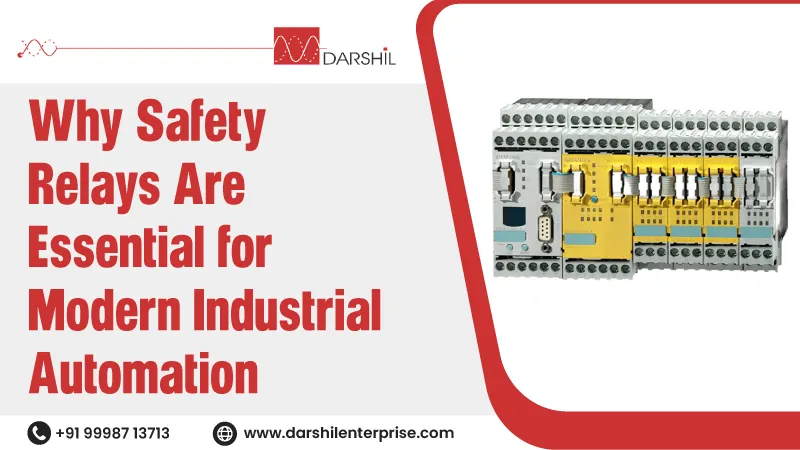
Industrial automation depends on controlled processes, predictable outcomes, and protected human involvement. As machines become faster and more complex, safety becomes a design requirement, not an afterthought. Safety relays play a direct role in controlling risk inside automated systems. They monitor safety functions and respond instantly when conditions move outside defined limits. Darshil Enterprise provides dependable solutions aligned with modern industrial demands.
Understanding safety relays in industrial automation
Safety relays are dedicated control devices designed to monitor safety inputs and activate safety outputs. They act as decision points inside electrical control systems. When a safety device such as an emergency stop, light curtain, or safety gate changes state, the safety relay evaluates the signal. If the signal indicates danger, the relay interrupts power to hazardous machine parts. This interruption happens within milliseconds. The goal is to reduce the chance of injury and equipment damage.
In modern automation, machines operate with minimal human supervision. Operators still interact with equipment during setup, maintenance, and fault correction. Safety relays manage these interaction points. They bridge human presence and machine motion. Without safety relays, automated systems rely on basic relays or software logic alone. That approach increases failure risk.
Why safety relays matter in automated environments
Automation improves productivity but also raises exposure to mechanical, electrical, and process hazards. Safety relays reduce these hazards by controlling access to machine energy. They handle single or dual channel safety circuits. Dual channel designs detect wiring faults and component failures. This detection supports safer shutdown behavior.
Safety relays also help industries follow regulatory frameworks. Many industrial safety standards require monitored safety circuits. Safety relays provide this monitoring at the hardware level. They reduce dependency on software-based safety alone. Hardware safety adds an independent protection layer.
Industries using automated conveyors, robotic arms, presses, packaging lines, and CNC machines depend on safety relays daily. A failed safety function can stop production or cause injury. Safety relays help prevent both outcomes.
Core functions of safety relays
Safety relays perform several critical functions inside control panels. They monitor emergency stop circuits. They supervise safety gates and access doors. They evaluate light curtains and laser scanners. They check two-hand control systems used in presses. They manage safe stop commands for motors and drives.
Each function follows a defined logic sequence. Input devices trigger a state change. The safety relay checks signal integrity. It then activates or deactivates output contacts. These contacts control contactors, motor starters, or drive enable signals. The logic remains simple, fast, and reliable.
Role of safety relays in compliance and risk reduction
Industrial safety standards focus on risk assessment and risk reduction. Safety relays help reduce risk by implementing protective measures defined during machine design. They support compliance with standards related to machinery safety and functional safety.
Using certified safety relays simplifies audits and inspections. It shows that safety functions rely on tested components. It also reduces liability exposure for plant owners. Safety relays provide predictable failure behavior. When faults occur, the system moves to a safe state.
Applications across industrial sectors
Safety relays appear across many sectors. In automotive plants, they control robotic cells and welding lines. In packaging units, they protect operators from high speed sealing and cutting machines. In pharmaceuticals, they manage access to clean room equipment. In food processing, they control conveyors and mixers. Infrastructure projects use safety relays in material handling systems. Power plants use them in auxiliary systems. Warehouses rely on them in automated storage and retrieval systems. Across all these sectors, safety relays deliver the same core value. They control risk at the point of danger.
Why safety relays support long term productivity
Safety investments often appear as cost centers. In reality, safety relays support productivity. They reduce accidents that stop operations. They reduce damage to machines. They reduce legal and compliance costs. Well-designed safety systems improve operator confidence. Confident operators work more efficiently. Maintenance teams spend less time responding to incidents. Production planning becomes more predictable. Safety relays support this outcome quietly and consistently.
Future trends in safety relay usage
Automation continues to evolve. Collaborative robots increase human machine interaction. Flexible manufacturing lines change configurations frequently. Safety systems must adapt. Safety relays continue to play a role due to their simplicity and reliability. Even as safety networks grow, local safety control remains essential. Safety relays provide this local control. Manufacturers also focus on compact designs and diagnostics. These trends improve panel efficiency and maintenance response.
Why Choose Us
Darshil Enterprise builds long term relationships with industrial clients by focusing on accuracy, application understanding, and dependable supply. The company studies operating conditions before recommending safety relays. Darshil Enterprise values clarity over volume and guidance over promotion. Customers benefit from consistent product quality, technical support, and responsive communication. As a trusted Safety Relays Dealer in Ahmedabad and Safety Relays Dealer in Gujarat, Darshil Enterprise supports projects with regional presence and industry awareness. This approach helps customers deploy safety systems that match real operational risk without unnecessary complexity.
Conclusion
Safety relays remain a foundation of modern industrial automation. They protect people, machines, and production continuity. Their role extends beyond compliance into operational stability. As automation expands, safety relays provide fast and reliable risk control at critical interaction points. Selecting the right safety relay and supplier shapes long term performance. Darshil Enterprise supports this need with focused expertise and consistent service. Industries that value controlled growth and responsible automation continue to rely on safety relays as essential components of their systems.
For expert guidance on safety relays and industrial automation safety, Call +91 98983 38702 or email info@darshilenterprise.com
Key Takeaways:
- Safety Relays Are Critical for Risk Control in Automation
They monitor safety inputs and instantly disconnect power when unsafe conditions occur, protecting both people and machines. - They Provide Reliable Hardware-Based Safety
Unlike standard relays or software logic alone, safety relays offer redundancy, fault detection, and predictable fail-safe behavior. - Safety Relays Support Compliance and Reduce Liability
Using certified safety relays helps meet industrial safety standards, simplifies audits, and lowers operational and legal risk. - Wide Industrial Applications Make Them Essential Components
Safety relays are used across robotics, conveyors, presses, packaging lines, and retrofit projects to manage hazardous machine interactions. - Correct Selection and Supplier Support Impact Long-Term Performance
Choosing the right safety relay and an experienced supplier ensures proper application, fewer nuisance trips, and stable long-term productivity.